
Know how it performs
and how long it lasts,
before you build it.
Multibody, vehicle dynamics and durability simulation for teams that build vehicles and machines.
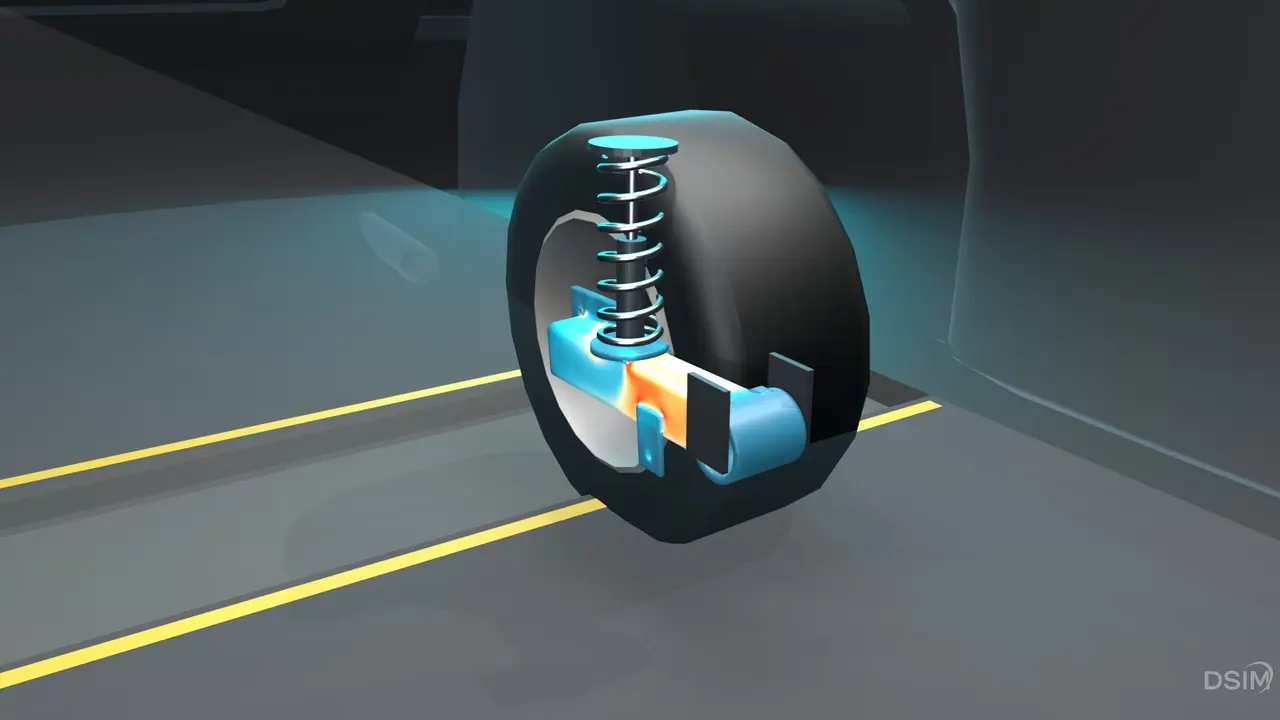
DSIM Reference Study: a welded light-truck trailing arm, its 36.2 lb second redesign, through a 3 in pothole at 20 mph. Solved in Adams Solver.
Simulation work for












Six ways multibody simulation pays for itself
Each one backed by a real program or a DSIM Reference Study. Pick one to see the proof.
 max
- In this model, everything is instrumented: every load, and the stress at 19,453 points on the arm. A test truck carries only the sensors you can fit and pay for.
- At 20 mph, the rear tire drops into a 3 in pothole and leaves the road. Its contact force falls to zero.
- The tire hits the far edge at 4,040 lbf, more than twice its static load. The arm's stress peaks 10 ms later.
- On a test truck, each reading needs a sensor, like this knuckle accelerometer. This pivot load would need one built for the part; in the model it is one more reading.
- Over the assumed road mix, this design's welds last about 140,000 miles, under half the target of 300,000 miles. The model found the shortfall and the fix: with a larger tube and a thinner wheel-mount plate, the arm is 2 lb heavier (38.2 lb) and reaches about 400,000 miles.
Peaks during the strike: knuckle acceleration +15.9 g, pivot load 2,200 lbf, weld toe stress −31.5 ksi.
Tire contact force, lbf
DSIM Reference Study, second redesign (36.2 lb). All values simulated.
What the numbers mean
Two stresses, measured two ways at the same instant. The colors and the arm peak are von Mises stress, always positive, on the arm's visible surface, leaving out 0.3 in around each weld toe, so the peak sits just beside the governing weld. The weld toe tag is the IIW hot-spot stress at that weld, compression negative: the one the weld life is calculated from. In all, the model records stress at 19,453 points over the arm's surface and at 404 points along its 16 welds. On a test, a strain gauge reads the one spot it is bonded to, chosen before the test, and a wheel-force sensor reads the load at the hub, not this contact force at the road. On a client program, the model is first checked against the channels the test does record. Acceleration: vertical, gravity removed. The frames and values on screen are from the study's first round of runs: with the final solver settings this strike's tire load is unchanged, and the acceleration, pivot load and weld stress run about 4 to 6 percent higher. The lives in miles are from the final runs.
Real loads for stress and fatigue
Every joint force, with no sensor to install, fed straight into FEA and durability work.
76x
weld life after three redesigns, found before any part was built
Reference study
Welded trailing arm, light-truck rear corner
- Problem
- Rough roads and impacts fatigue welded suspension arms; testing finds the weak spot only after hardware cracks.
- Modeled
- A flexible arm and an enveloping tire on eight road events, with stress at every surface node and along every weld.
- Result
- Original arm: about 5,200 miles of weld life. Final design: about 400,000 miles.
Two client programs
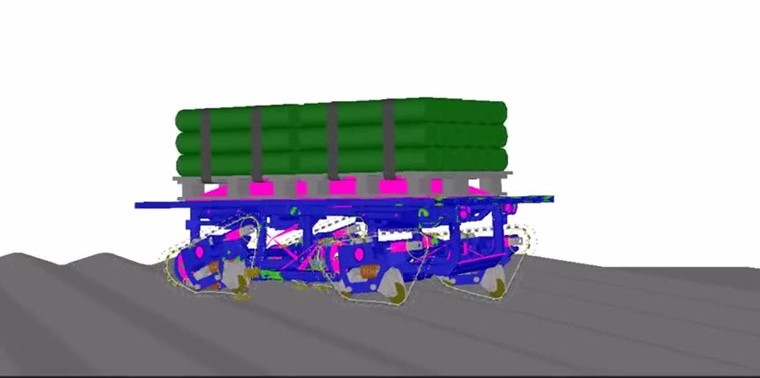
Validating an autonomous tracked vehicle before cutting metal
Stratom, Inc.
- Problem
- No prototype yet, and a high cost for a wrong first build.
- Modeled
- Full-vehicle multibody model with track systems over terrain and obstacles, transient stress on the flexible frame.
- Result
- Design changes made from the model; the prototype build went ahead on time and under budget.
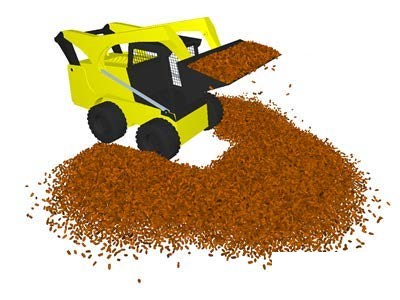
Predicting bucket loads on a machine that did not exist yet
A heavy-equipment OEM
- Problem
- Hydraulics to size at concept stage, and no machine to measure.
- Modeled
- Discrete element material simulation coupled to the machine model through the dig cycle.
- Result
- A power envelope for sizing the hydraulics while the design was still open.

Darren Simoni, Principal
Building multibody models since 1996: Adams Solver, durability and loads, ride and handling, tire and terrain models, wheeled and tracked vehicle dynamics, FEA, and correlation of models to physical test.
Post Falls, Idaho.
Two kinds of teams call DSIM
Some want a design proven in simulation before committing to hardware. Others already built the machine and have a problem they can't explain: a vibration, an instability, a failure that testing alone won't diagnose. If deep multibody simulation or vehicle dynamics expertise isn't part of your core team, DSIM can help with both.
How a first project starts
- A free 30-minute callThe machine, the question and the decision it supports.
- A short scope noteWhat will be modeled, what is assumed, what you receive and when.
- The model and the answerBuilt, checked against test data, hand calculations or published measurements, and delivered with its assumptions stated.
A first project can be a pilot: one real question, scope agreed before work starts, no software to buy.
NDA-ready and US-based.
“Darren brought our simulation capacity to an entirely new level. We engineered an innovative hybrid mining shovel and validated new design and controls concepts through simulation, without spending excess money on tests.”